
How Adoption Became Part of a Survival Story for this Birth Trauma Survivor
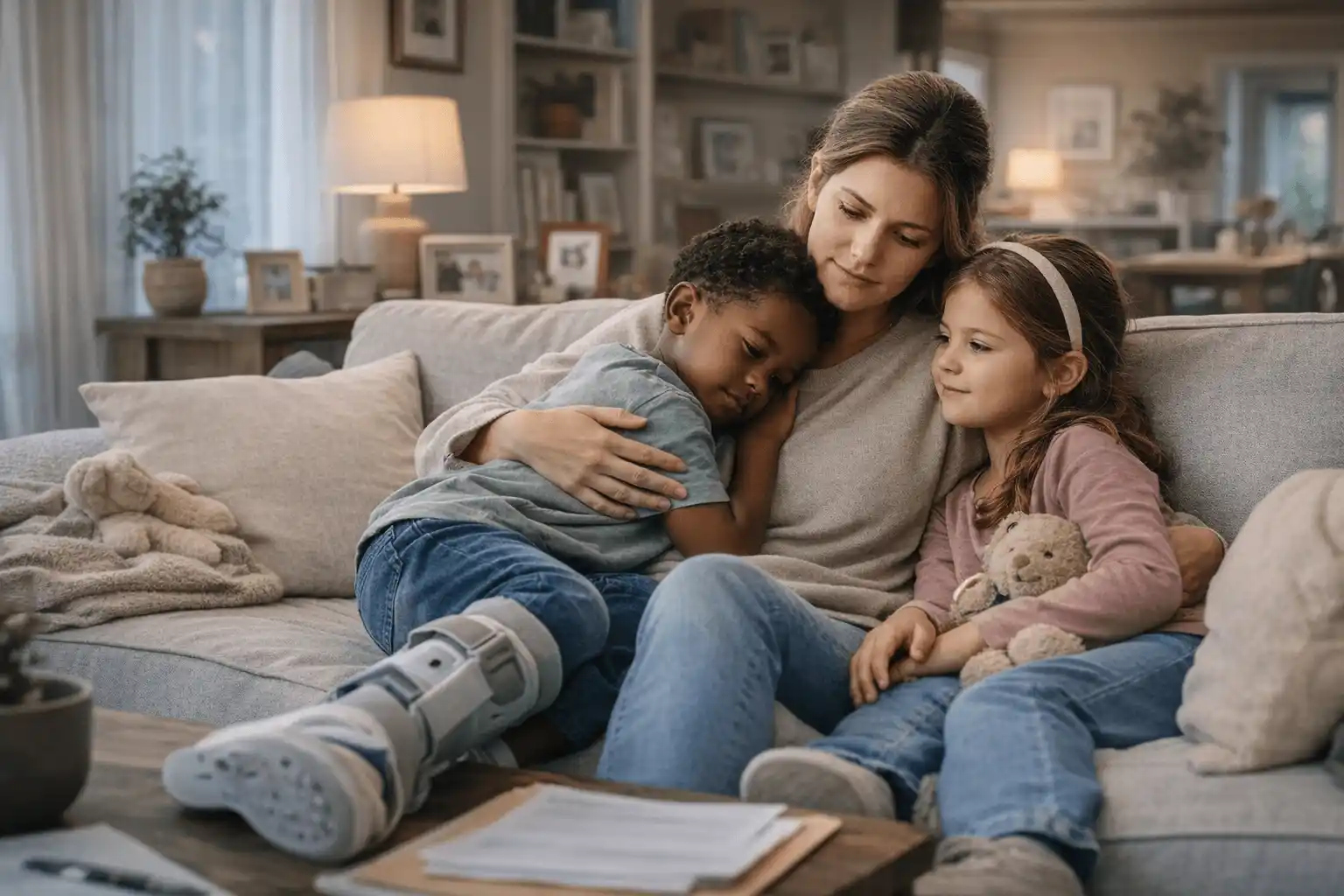
Most people think of adoption as a single decision, a moment when a family says yes. But for Catherine Garrett, founder and host of the Birth Trauma Stories podcast, the path to adoption was shaped by a near-death experience, a life-altering disability, and a family legacy of opening their home to children in need. Her story shows how adoption can intersect with the most unexpected chapters of a family's life.
Catherine experienced an amniotic fluid embolism (AFE) during the birth of her second daughter. AFE is a rare and often fatal complication that occurs in approximately 1 in 40,000 births, according to the Amniotic Fluid Embolism Foundation. The mortality rate ranges from 20 to 60 percent depending on diagnostic criteria, and the condition remains the second leading cause of peripartum maternal death in the United States, according to the National Library of Medicine. Catherine was given a 1% chance of survival. In this episode of Adoption Utah, she sits down with host Donna Pope to talk about how surviving the unthinkable reshaped her family, why her parents' decision to foster and adopt left a lasting imprint on her heart, and what it means to build a life around both grief and gratitude.
A Medical Crisis That Changed Everything
Catherine's birth trauma began during labor with her second daughter. She had chosen a VBAC (vaginal birth after cesarean), and that decision placed her at the one hospital equipped with the ECMO machine she would need to survive. While resting with an epidural, she felt her heart begin to race. Within moments, she was seizing and in full cardiac and pulmonary arrest. Her daughter was delivered emergently with an Apgar score of two, requiring resuscitation and intubation. Over the next nine days in a medically induced coma, Catherine underwent seven surgeries, including a hysterectomy and open heart surgery, suffered a stroke, needed stents, and her heart stopped six times in the first 24 hours.
The ECMO machine, which functions like dialysis but for the heart and lungs, became her lifeline. Research published in the journal Circulation found that overall one-month mortality for adult ECMO patients was approximately 60%, underscoring how dire Catherine's situation was. She was hospitalized for a month, far shorter than the six to eight months doctors initially projected, and came home to a two-year-old and a newborn with no long-term deficits. But coming home meant confronting a new reality. Catherine lives with drop foot from her stroke, a chronic pain syndrome, POTS, chronic fatigue, and an enlarged heart that still requires ongoing testing more than six years later.
The Unseen Toll on Families
Catherine's story extends well beyond her own medical journey. Her husband, an engineer by training and a natural caregiver by instinct, suddenly found himself managing a newborn, a toddler, his wife's complex medical schedule, medications, household responsibilities, and his own full-time job. According to the National Alliance for Caregiving and AARP, spousal caregivers are the most likely to report fair or poor health, with 27% doing so compared to 15% for all other caregiver relationships. Catherine's husband eventually experienced caregiver fatigue that lasted six to nine months and required the family to rally additional support from their church, extended family, and a retired volunteer who took over driving Catherine to rehab appointments.
The impact on Catherine's older daughter has been especially significant. She had two years with an able-bodied mom who carried her in a sling, nursed her for nearly 20 months, and kept her close at all times. After the AFE, that relationship changed overnight. Catherine could not pick her up because of open heart surgery. She could not let her daughter rest on her chest. Years later, her daughter has expressed that she feels alone in her experience, that she doesn't know anyone else living with a mom who has a disability. Catherine's mother-in-law came every weekend for the first six months, doing dishes, cooking, cleaning, and folding laundry. Other supporters covered a year of lawn care, donated money, and brought meals. Catherine estimates the family has spent nearly a quarter of a million dollars out of pocket on her medical care to date.
When Adoption Runs in the Family
Catherine's connection to adoption began long before her own medical crisis. Her older sister was adopted by her biological father, and growing up, adoption was simply part of how the family worked. Catherine points out with a laugh that half her siblings are adopted and that her mom ended up with six kids after only three pregnancies, thanks to a set of twins and two foster-to-adopt placements. Her parents became foster parents in Florida, initially insisting they were only going to foster, not adopt. Their first placement was a young boy who stayed for nine months before being reunified with his biological father, a departure Catherine describes as both grief-filled and joyful at the same time.
Their second placement came directly from the hospital, a newborn going through drug detox. That boy was eventually adopted on what would have been Catherine's great-grandfather's 100th birthday, a date that also coincided with National Adoption Day. A second baby with significant health challenges was adopted shortly after because Catherine's parents wanted him to have a companion and were concerned about his medical needs being met elsewhere. The most recent data from the Adoption and Foster Care Analysis and Reporting System (AFCARS) shows that in fiscal year 2024, 46,935 children were adopted from foster care, a decrease of over 26% since 2019. Meanwhile, 15,379 youth aged out of the system that same year without finding a permanent family. According to the Annie E. Casey Foundation, approximately 22 to 30 percent of youth who age out experience homelessness during the transition to adulthood.
An Open Heart for More
Catherine's hysterectomy during the AFE means biological children are no longer an option. But she has long felt that her house has room for more. She and her husband are not in agreement on timing, and she respects that. She prays about it and remains open to whatever path unfolds, including the possibility of welcoming an adult who has aged out of foster care. She has long been the person who opens her table to anyone without a place to go on the holidays, and she sees that instinct as connected to the adoption legacy her parents modeled.
When asked what she wants her children to carry with them when they leave home, Catherine paused before giving an answer that has become her family's foundation: the belief that they are capable of doing hard things. That belief, rooted in her faith, carries her through the days when rehab feels impossible, when parenting from bed is the best she can offer, and when the gap between her former life and her current one feels wide. It is the same belief that makes adoption feel less like a plan and more like an open door.
Catherine's story covers ground that most people will never walk. A 1% chance of survival. A marriage tested by care giving. A daughter is searching for someone who understands. And an adoption legacy that keeps her heart open for whatever comes next. If any of that speaks to where you are, or where someone you love is, this episode of Adoption Utah is worth your time. You can also find Catherine's work at the Birth Trauma Stories podcast, where survivors of perinatal trauma share their experiences in a safe, supportive space. To learn more about Heart To Heart Adoptions and the families they serve, visit their website. And if you know a young person aging out of foster care who needs a place to belong, consider being the person who makes room at the table.
Definitions
Amniotic Fluid Embolism (AFE): A rare, life-threatening birth complication in which amniotic fluid or fetal material enters the mother's bloodstream, triggering a severe immune response that can cause cardiac arrest, respiratory failure, and uncontrolled bleeding. It occurs in approximately 1 in 40,000 births.
ECMO (Extracorporeal Membrane Oxygenation): A life support machine that takes over the function of the heart and lungs when they can no longer work on their own. Think of it as dialysis, but for the heart and lungs instead of the kidneys. It is considered a last-resort intervention.
Apgar Score: A quick assessment given to newborns at 1 and 5 minutes after birth, scoring appearance, pulse, grimace, activity, and respiration on a scale of 0 to 10. A score of 7 or above is considered healthy. Catherine's daughter was born with a score of 2.
VBAC (Vaginal Birth After Cesarean): A vaginal delivery after a previous pregnancy was delivered by C-section. It is a decision that carries specific medical considerations and is made in partnership with the care team.
POTS (Postural Orthostatic Tachycardia Syndrome): A condition in which the heart rate increases significantly upon standing, often causing dizziness, fainting, and fatigue. Catherine developed POTS as a result of her medical crisis.
Drop Foot: A condition in which a person has difficulty lifting the front part of the foot, often caused by nerve damage or a stroke. Catherine uses an AFO (ankle-foot orthosis) brace to assist with walking.
Caregiver Fatigue: A state of physical, emotional, and mental exhaustion experienced by someone providing ongoing care to a loved one. Catherine's husband experienced this for approximately six to nine months after her medical event.
Survivorversary: A term used in the AFE and trauma survivor communities to mark the anniversary of surviving a life-threatening event. Catherine's family celebrates hers nine days after her daughter's birthday, the day she woke from her coma.
#AdoptionUtah #BirthTraumaStories #AdoptionStories #FosterCareAdoption #PerinatalTrauma #AFESurvivor #AdoptionJourney #FosterToAdopt #HeartToHeartAdoptions #AdoptionCommunity #DisabledMom #CaregiverSupport #AgingOutOfFosterCare #YouCanDoHardThings
Follow or Subscribe to Adoption Utah on your favorite platforms: Website: www.AdoptionUtah.org | YouTube: @AdoptionUtah | Twitter/X: AdoptionUtah | Instagram: AdoptionUtah | LinkedIn: Adoption Utah
Follow Donna Pope: LinkedIn: Donna-Pope-41652ba/
Follow Catherine Garrett: LinkedIn: @Catherine-Garrett-8ab422249 | Website: BirthTraumaStories.com | YouTube: @BirthTraumaStories | Instagram: @BirthTraumaStoriesPodcast




Comments